I've had a number of inquiries lately for multiple services bundled together, and thought I should share some thoughts from a planner's perspective on the pros and cons of this. Not only have these inquiries been for multiple services packaged into one deal, but they've been with short notice, and they've been on seriously strict budgets.
All three of these factors are a real recipe for disaster. From a Bride's perspective, I totally get it. The fewer people you have to deal with when planning a wedding, the sooner it's all booked and put behind you, and the fewer people you have to keep track of. BUT, when you start combining more than 2 services, you put yourself at greater risk of having a REALLY botched day should anything go wrong. Here's what I mean:
On the pro side, combining services with one vendor, can result in them throwing you a steeper discount, because the vendor's margin is suddenly spread across more work. This means they get a larger ticket of revenue, you get more services, and presumably, at a much better price. You have 1 vendor to touch base with in the month preceding your big day, instead of 4 or 5. And you can leverage the seriously broad creative talent that this industry has to offer you. You can ensure that by having decor, wedding day coordination and say florals all done by the same vendor, that they will carry a similar look and feel, because they've been designed, assembled, delivered and set up by the same person. A consistent look and feel gives that extra look of panache that your guests will sit back and enjoy while they partake in the fabulous meal you've organized for them. Who could ask for anything more, right?
On the con side, when you give more than one service to a single vendor, your risk increases (if that business is a small one), should anything go horribly awry and they can't deliver on your big day. Secondly, depending on what services you have contracted with them, depending on their business size, you could see a degradation of quality in what is delivered. Finally, if you know that 1 plus 1 plus 1 equals 3, don't expect that by asking a vendor to provide three services, that it won't be costing you for 3 services. Every thing you ask a vendor to do is going to cost your vendor money, labour and time. By being in business, they expect to make a profit (even if they expect a small profit), but they definitely don't open a business to lose their own money. And finally, if you're asking one vendor to perform most of the services for your big day, where are the checks and balances if something goes wrong or is done incorrectly? Hopefully you have bigger and more important things on your mind on your wedding day, than policing your single vendor. You need to understand how much risk you're willing to accept on your wedding day.
If you're asking your vendor to give you everything at wholesale cost, what's ultimately in it for them? Everyone loves word of mouth advertising - testimonials are the best marketing tool one can get, but not every job can be at a loss for the hopes of a great testimonial - nor should they be. Consider what it would be like if you went in to the office every day, and all your employer did was pay you for a portion of the gas you used to commute in to the office and back home again. It wouldn't be worth your time right? And would you do a good job for that employer? Probably not. Where would be your motivation?
As a rule of thumb, when I'm asked to do more than one service, as a vendor, I'm super excited about it. It means I can show more of my creativity, and more than anything else, it gives me more to do (I'm a bit crazy this way - if I'm not stretched to my limits, I don't seem to be content). But I also make it a rule, not to book more than 2 services that require me to execute on the wedding day. I'm more than happy to combine preparatory services, or things that can be done and delivered in advance of the wedding, but I know how big a labour pool I have to draw from, and I want everything I deliver to be of the utmost quality.
As a small independent business owner, I hate saying "no" to any job. And while it would have to be a major catastrophe for me not to execute on a job, a major catastrophe is always a risk. If I have committed to doing day of coordination, floral centrepieces, pew bows, and table decor and anything were to happen to me, how much of my client's day would be potentially ruined? It's something I consider, even if my potential client's have said they're okay with it. I have people I can call for day of coordination or odd jobs here and there, but the disruption that this would all cause, would be incredible, and hugely disappointing for any bride and groom. And my risk would be that if the couple weren't already aware of my predicament, the first assumption would be that I outsourced the work, and that I didn't deliver to my commitments in the way that they trusted I would. This is not the impression any small business owner would want to leave a client with.
If a company has said yes to booking multiple critical services quickly, this should give you enough pause to ask at least one follow up question: Is the company big enough, and does it have enough people employed within it, to execute all of those services on the day of your wedding, regardless if the person committing to it is there to oversee it or not? And if the vendor is willing to do a job at a loss, ask yourself and ask them why? Maybe it's a good answer, and maybe you've won the lucky draw of being that special couple who's getting the freebie for the hopes of a great review...and if you are - do the vendor a big favour in return, and give them the review. No deal is a good deal if it's not a win win for everyone! But maybe they're saying yes, just to get the next job too. As a customer, I want to work with vendors who are just as careful with my money as I am, and who care just as much about my day as any of my guests would.
Which brings me to my final point (and it's made only with the intent to save future brides from taking on or seeking out awful risks). If you want steep discounts, and you want the convenience and simplicity of a single point of ownership, work with a planner. Working with a planner will help you to divide the work load in a way that's comfortable for you, and it will give you the single point of contact you're looking for, for whatever combination of services are suitable to you. By hiring the planner, they take on responsibility for managing the vendor relationship, and the vendor's execution on your big day. And yes, they can help you make that 1 plus 1 plus 1 scenario, to become a total of 2.5 instead of 3.
Monday, July 6, 2009

Wednesday, July 1, 2009
Flower Stamina!
So, last week I blogged about centrepieces I donated to the Canadian Mental Health Association of Peel's Annual General Meeting!
They were a big hit, and people seemed really pleased to have them play a part in their annual celebration. Personally, I admire the work that the CMHA does on a daily basis to promote mental wellness, and to aid the mentally ill in their recovery process.
They were kind enough to let me keep a few of the arrangements as a matter of a personal little experiment I wanted to conduct. One that I had hoped (and am pleased to report), would help my current and potential clients when they are considering who to contract with for their wedding floral needs.
The experiment was in an effort to answer the question: how long will these last when the client takes them home? The purpose of this experiment was two fold: 1) find out what my threshold is with these pretty hearty flowers in terms of how early I can start to get them put together before the client's big day; and 2) to find out how long I can make them last for my client after their big day. I firmly believe that with the cost of flowers, as well as many other details of a woman's wedding, that there should be a little life left in things after the event has come and gone. In particular with flowers, I know from personal experience, how disappointing it can be when your bouquets don't even stand up til you get to walk down the aisle. And even more so when you give the centrepieces away to your guests, who report back to you after you get back from the honeymoon that they all withered away and died by the next morning.
Every single cost of a wedding detail is an investment, or at least it should be. This is one of the reasons I'm in business, and it's THE reason I chose the business name I did. You can have any budget in the world, but if you don't get mileage out of the things you purchase within that budget, you've completely wasted your time and your money.
With that, I wanted to share the results with you. I hope that when you choose your florist, you'll consider these results, and you will ask how far in advance your flowers will be assembled! It's critical!!!
The smaller centrepieces (containing green mums, white carnations and baby's breath, were secured using floral foam that was water absorbant. These centrepieces lasted a full week before they began looking a little worse for wear. With additional watering, this may have been extended another 3 days to a week.
The taller vases are 8 days in and still going strong. I suspect they have another 3 days before they start turning, but check out the life that is still in these arrangements!
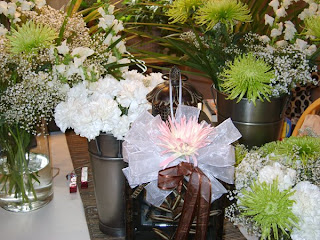
Seriously speaking, if your florist isn't willing to commit to a pre-assembly time frame, or you hear that they will begin assembling a week or more in advance, you should expect to get a very short life out of your arrangements. Consider a smaller florist who takes on one or two jobs per weekend...or pick a very large florist who has enough staff to make a shorter turn around commitment. Ideally, for your floral investment to pay off, you should aim for at least 4-5 days of life after your big day (accounting for the frenzy and high degree of stress they'll be under during your big day). At least that much should be feasible!
Happy Floral Hunting!
Pew Bows for Zen
A while back, I signed up with a client to do Day of Coordination for her wedding on July 11th. As her wedding approached, the situation had changed slightly, and my client asked me if I wouldn't mind using her deposit for something other than what we originally had planned to do.
Of course, in this economy, it wasn't surprising to hear that a change may be required...in fact, it's something that a lot of bride's are coming up against. The best thing to do in every situation is roll with the punches, letting the hit glance off your shoulder, and find another way! And you need vendors who will be able to help you roll with those punches as much as possible. So of course I said that would be just fine. What would my client like to have instead?
"Pew Bows".
Awesome! So here we are after a few days of twisting, tying, and twisting, fitting, and tying again! I love the result, and I think she will too! The bride's colours are soft pink and chocolate brown, and her star flowers are roses and gerbera daisies of course! So here we have a handmade, custom pew bow, completely coordinated to her wedding themes, up to and including a high end fresh touch silk gerbera daisy!! Enjoy.

Monday, June 29, 2009
Pew Bows for Cutie D
We had the pleasure of doing pew bows for a bride in Mississauga this past Saturday. Her colours were hot pink, black, and of course white!
These were a lot of fun to build, and it was a lot of fun seeing them actually marking her aisle, after months of chatting about the design.

Congratulations Cutie D!! All the best for a happy and prosperous life together!

Wednesday, June 24, 2009
Flowers, Flowers, Flowers
Yesterday, I had the honour of donating all of the centrepieces for the Annual General Meeting of the Canadian Mental Health Association for Peel Region.
The organization's logo is green and white, and in keeping with that theme, we went with green spider mums and bright white carnations, with gypsilium for filler. We managed to deliver 27 centrepieces in total, and did this on a really reasonable budget(just under $1000). It just goes to show you, that carnations and baby's breath aren't evil after all (so long as they stay out of your hair, they smell and look beautiful on any table, and in most arrangements)...and they are so budget friendly, that they allow you to really pick a real star for a silhouette flower in your major pieces. If you like ranunculus, peonies, and mums, Carnations can usually be used at fractions of the cost, they are available all year round, and they create the same affect as the others, in every possible colour of the rainbow - and some mixes thereof too!!
Hope you love them, as much as I did. And I know that the group enjoyed them last evening (some even got snuck out the back door...wink, wink...). What a wonderful compliment it is to know that your centrepieces were nice enough to take home!


Friday, June 19, 2009
Last Minute Weddings for Less
So, I'm really interested lately in how the economy is affecting the wedding industry from a number of fronts - most of all of course, I'm interested in knowing how to continually maximize dollar values for my clients. In that vein, and given I guess that June is wedding month almost everywhere in North America, I'm finding plenty of information on how to host a fabulous wedding with less. While I don't believe that there is a grand conspiracy to make weddings as expensive as they can (cuz I've obviously landed outside that clique), but I do know that there are always ways to creatively meet your budgetary constraints. You just have to be realistic about your expectations. Having a smaller wedding with a cash bar on a Sunday afternoon, is just as fabulous (if not more so), than an evening soiree at the Four Seasons on a Saturday night in June!
Happy Reading!
Happy Reading!
Last-minute weddings for less
Who says you need a year to plan your nuptials? Flexibility and the ability to make quick decisions can create an affair to remember in less time and for less money.
Some sought-after wedding vendors convince brides that it takes a year or more to plan a wedding. After all, don't all the best venues and suppliers book far in advance? Not necessarily. While they don't like to advertise it, many hot spots can host several weddings at once, even on prime-time Saturday nights.
Shhhh . . . here's another secret: If you have a little flexibility and make decisions fast, you can save big bucks on your wedding day.
As Chris Mohr, a longtime wedding minister at Foothills Chapel in Colorado, explains, "People pull off pretty elaborate funerals in just a few days all the time." Not to be macabre, but weddings aren't that different -- location, ceremony, flowers, music, food. . . .
According to Alan Fields, co-author of "Bridal Bargains: Secrets to Throwing a Fantastic Wedding on a Realistic Budget," the average American wedding costs between $25,000 and $35,000, depending on whether jewelry is included. However, Fields believes averages can be misleading. "A few weddings over $100,000 throw off that figure dramatically," he says. "The true median is closer to $15,000." That means half of all weddings cost less than $15,000 and half cost more.
"There are a number of things the wedding industry promotes to puff up its image: that it is recession-proof; that everybody is spending $35,000 on a wedding," Fields says. "But we're seeing a lot more last-minute weddings in the last year."
So as weddings take a more speedy approach, here are some ways to get hitched in a hurry without spending too much money.
1. Negotiate discounts, custom packages
Some wedding vendors offer discounts for bookings made with little advance notice (usually one to 10 weeks) because they'd rather fill gaps in their schedules than let the slots go fallow. Discounts can range from 15% to 30% off advertised rates. "We're hearing from more and more wedding vendors that they would much rather book a wedding and strike a deal than let the person walk out the door," Fields says.
Vendors most likely to negotiate:
Reception site managers and caterers.
Bakers.
Gown shop proprietors.
Florists.
DJs and bands.
Photographers and videographers.
While Fields likens counting on last-minute deals to "playing chicken with your wedding budget," he believes that politely negotiating discounts or custom packages is always a good idea.
Wedding vendors typically work based on set packages with set pricing, which they hope ensures everyone spends a minimum amount. It's common inside wedding industry circles to hear vendors such as a DJ say things like, "I won't leave the house for less than $1,000." But, that's not always true.
The trick, Fields explains, is to ask for a custom package that better fits your budget. "You have to remember that most wedding vendors view themselves as artists -- 'artistes,'" he says. "So, you kind of insult them if you ask, 'What kinds of discounts do you have?' You have to make them feel like they are still creating art. By custom designing a package for you, it makes them feel like they are putting a little bit of personal expression into it."
Essentially, wheeling and dealing is easier for vendors who have unused capacity and more flexibility. A baker and support staff, for example, can handle perhaps six cakes in one day, whereas a photographer can shoot only one wedding at a time.
Having an open bar at your wedding? Wine-shop owner Howard Silverman recommends some of his favorite inexpensive wines. The Wall Street Journal's David Kesmodel reports.
2. Winnow the guest list
Shorter notice typically means fewer guests attend, and the more time families ponder guest lists, the longer those lists get.
Precious Knudsen started planning two weeks before her Aug. 5, 2006, wedding in the Hamptons. Prior to her fiancé's redeployment to Iraq, she threw together a simple beach wedding and restaurant reception for under $7,000.
"The wedding wasn't going to be big anyhow because we gave people 10 days' notice," she says. "We invited 50 people and around 30 to 40 showed up. We saved thousands upon thousands of dollars, without a doubt. If we'd had more time, we would have invited more people, and more would have shown up. We would have needed a bigger venue, a more traditional type of venue."
Fewer guests also mean less food. Many quick-planning brides opt for nicer food for fewer people, rather than passable food for hordes. Even with the gourmet upgrades, the food bill is much lower. Compare a $20-per-person buffet for 200 guests to a nicer $50-per-person sit-down meal for 40. That's $4,000 on food alone versus $2,000.
3. Plan simpler events
Less time results in simpler weddings. All those personalized extras cost time and money. When you don't have time, you're less likely to fall into the bridal vortex that convinces you oodles of add-ons are necessary. Guests don't notice if the candy is monogrammed. They really don't.
"Some of this actually goes back to the way we used to do weddings. Keeping them simpler," says Elise Enloe, a master bridal consultant certified by the Association of Bridal Consultants who plans weddings in Florida.
"You don't have to serve a seven-course meal and have a 20-piece band," Enloe says. "With this economy, that's what we're seeing. People are cutting back and doing with smaller weddings, or they are delaying the date, but the No. 1 response is to cut back."
One often-overlooked option is to host the wedding at home. After all, you know for sure your place isn't already booked, and its size likely will keep the guest list small.
4. Select off-the-rack options
More stores offer inexpensive wedding dresses in many sizes right off the rack or for delivery in two to three weeks. No rush shipping. No drawn-out alterations.
Fields explains that gown stores are under increasing pressure to compete with online discount dress outlets. "The reality is that many gown manufacturers and bridal accessory makers say you need eight weeks for special orders. But often brides go into the shops and say, 'I've only got six weeks.' Then they tell us a miracle happens. All of a sudden, bridal shops figure out how to get these things without rush fees."
And, even if there is a fee, it's typically just $50 to $100, which isn't terrible if you're saving big bucks elsewhere.
Zaira Knudsen, whose wedding to Precious Knudsen's uncle came after just three months of planning, says she walked into a discount bridal store, picked out a dress and walked out that day with it in hand. "When you don't have so much time to think about it and make decisions," she says, "then you have to do it fast and pick your best option."
With only a few weeks or months, she adds, "You don't have the chance to change your mind."
5. Be adaptable
Melissa Bauer, spokeswoman for TheKnot.com, a popular online wedding site, doesn't recommend fast planning as a money-saving strategy. Instead, she suggests that all brides comparison shop to find good deals.
But when prodded to categorize what kind of women best fit the quick-plan scenario, she describes brides who:
Are incredibly flexible and willing to take what's available as far as dates, times, venues and vendors.
Focus more on the big picture than on the tiny details.
Are willing to compromise and potentially toss out things they wanted.
For example, rather than a Saturday wedding, go for a Thursday, Friday or Sunday. And compared with an evening affair, morning and afternoon time slots often cost significantly less. Add these concessions to a wedding planned fast and you can compound your savings.
Despite what traditional wedding planning timelines say, it's entirely possible to do it in much less time.
Says bridal consultant Enloe, "If you're going to plan a wedding in a year or 18 months, chances are you're going do to a lot of stuff in the first three months and in the last three months, with a three- to six-month window in the middle where not much happens."Having an open bar at your wedding? Wine-shop owner Howard Silverman recommends some of his favorite inexpensive wines. The Wall Street Journal's David Kesmodel reports.
4 ways to make it easier on yourself:
Leverage the Internet and telephone to do research before you burn time (and gas) seeing places and people in person. Then negotiate face to face.
Choose venues that offer package deals and let them bundle services for you.
Be decisive. Don't sweat every detail.
Consider hiring a wedding planner (typically $50 to $75 per hour), especially if you want to get married in peak season. Rather than making 30 or more calls to find each vendor, a planner can likely make fewer than five and get you hooked up, including special rates.
This article was reported by Roxanne Hawn for Bankrate.com.
Updated June 2, 2009
Thursday, June 18, 2009
Walmart of Weddings is Thriving
I found this article on MSN yesterday, and felt it was worthy of noting where I interact with my bride's.
Walmart of Weddings is Thriving
One-third of brides marrying in the US this year will be wearing a polyester wedding dress from David's Bridal that costs as little as $99.[Related content: wedding, retail, Wal-Mart, economy, savings]By The Big Money With June upon us, consider this: More than 2.2 million women will get married in the United States this year. About one-third of them will be outfitted by one company: David's Bridal. With more than 300 stores throughout the country and a growing online presence, the retailer offers unbeatable prices on a wide selection of mass-produced gowns. While the average wedding gown costs $1,075, according to Condé Nast Bridal Media, the average David's Bridal dress retails at $550. Some sell for just $99. David's Bridal has been called the "Wal-Mart of weddings," and, like the big-box giant, it may be poised to emerge from the recession as a more formidable retail force.As many small, independent dress shops have shuttered due to the economic downturn, David's Bridal is in the midst of what it calls "an ambitious expansion program." The privately held company doesn't publish revenue figures; Thomson Reuters estimates its sales were $683 million in 2008."I would say it's actually performed relatively well in this recession," says Jackie Oberoi, a credit analyst at Standard & Poor's. She estimates that David's Bridal has added between 15 and 30 stores a year since 1999. Even in the past year's gloomy retail environment, it opened 20 stores. The brand's budget-friendly reputation appears to be paying off.As the retailer unveiled its new Manhattan store this spring, CEO Robert Huth acknowledged the company's unique position, saying, "Although many retail stores have been closing locations due to difficult economic times, David's Bridal is proud to open its heart and doors to the people of New York City." The newly opened store has a utilitarian feel; racks and racks packed with plastic-wrapped gowns, organized by price and size (2 through 26). There are no champagne toasts or doting bridal consultants. Brides pick through the dresses like they're shopping for groceries.The styles range from trendy cuts to classic silhouettes, but almost all the gowns have one thing in common; they're made of the fabric that no bride wants to speak of too loudly: polyester. Still, customers don't expect to find high-end silk gowns at David's Bridal. And brides have never been drawn there because it's fancy. "The first store didn't even have carpet on the floor," says Phil Youtie, former executive and founder of the David's Bridal empire (the company gets its name from a small bridal shop that Youtie bought out early in his career). In 1990, Youtie began selling deeply discounted gowns on pipe racks in a Florida warehouse. At the time, most bridal shops stocked dresses only in sample sizes, so customers would have to wait months for their own dresses to be manufactured, delivered and altered."We wanted to have all of our dresses right then and there," explains Youtie. David's Bridal offered not only on-the-spot purchases but bargain-basement prices as well. "Everybody loved the idea," says Youtie.Well, not everybody loved it. In fact, lots of people in the wedding industry loathe David's Bridal. That's because, for years, bride after bride has jilted her local boutique and purchased a dress from the chain instead. "Whenever a David's opens up, business drops instantly," says Sally Conant, the executive director of the Association of Wedding Gown Specialists. Most small shops can't afford to stock dresses in every size or discount their merchandise as deeply as David's Bridal does. Because its dresses are typically made with inexpensive materials, manufactured abroad and purchased in bulk, they're some of the least costly gowns available. As a result, David's Bridal claims an estimated 50% of the $600-and-under wedding-dress market. Engaged couples looking to hold down reception costs don't have to settle for a boring and tasteless wedding cake, reports Michelle Kung of The Wall Street Journal. (June 9)The economic downturn could help David's Bridal capture even more market share. While the recession hasn't deterred couples from tying the knot, it has shrunk their budgets substantially. The average cost of getting married in the United States slipped in the first quarter to $19,212, according to the Wedding Report, a market research firm. That's down from $21,814 last year and $26,450 in 2005. Brides-to-be are opting for cupcakes instead of wedding cakes, downsizing their guest lists and, yes, compromising on what may have been the dress of their girlhood dreams. According to a recent survey of brides-to-be, 55% plan to spend no more than $600 on their dresses.That means that those who may not have set foot inside a discount shop like David's Bridal in the past are venturing in. "I think they're considering it even more than ever," says Gail Malecot, a bridal retail consultant. "These girls want to spend less on their weddings, across the board, from dresses to chair covers," she says. The real test for David's Bridal -- and most budget-friendly retailers today -- comes when the economy rebounds. Of course, therein lies the big difference between David's Bridal and Wal-Mart Stores (WMT, news, msgs): People shop at Wal-Mart regularly, whereas David's Bridal is presumably seeing most of its customers for one purchase (or not much more than one).This article was reported by Caitlin McDevitt for The Big Money.
2 key messages came out of this for me - particularly for bride's who don't live in the US:
- Polyester isn't so bad at all - you can have a beautiful silk gown, but you risk being wrinkled before you walk down the aisle. A gown using some polyester will look great all day and all night long, will clean wonderfully, and will make the gown resaleable, reusable, and much, much, much easier to store.
- If you're struggling finding "the dress" at your local shops, please, please, please, consider either shopping at a second hand gown shop (like Gown Go Round in Newmarket, ON), or consider having your dress custom made. Custom Made gowns don't have to be more expensive than one off the rack - particularly if you're expecting to pay full retail price, AND it will fit you from the first moment you try it on. Add to this that it can be 100% you from top to bottom - alterations to change design (adding a sash here, a bow or bustle there, and a brooch for example) are already baked into the plan.
Walmart of Weddings is Thriving
One-third of brides marrying in the US this year will be wearing a polyester wedding dress from David's Bridal that costs as little as $99.[Related content: wedding, retail, Wal-Mart, economy, savings]By The Big Money With June upon us, consider this: More than 2.2 million women will get married in the United States this year. About one-third of them will be outfitted by one company: David's Bridal. With more than 300 stores throughout the country and a growing online presence, the retailer offers unbeatable prices on a wide selection of mass-produced gowns. While the average wedding gown costs $1,075, according to Condé Nast Bridal Media, the average David's Bridal dress retails at $550. Some sell for just $99. David's Bridal has been called the "Wal-Mart of weddings," and, like the big-box giant, it may be poised to emerge from the recession as a more formidable retail force.As many small, independent dress shops have shuttered due to the economic downturn, David's Bridal is in the midst of what it calls "an ambitious expansion program." The privately held company doesn't publish revenue figures; Thomson Reuters estimates its sales were $683 million in 2008."I would say it's actually performed relatively well in this recession," says Jackie Oberoi, a credit analyst at Standard & Poor's. She estimates that David's Bridal has added between 15 and 30 stores a year since 1999. Even in the past year's gloomy retail environment, it opened 20 stores. The brand's budget-friendly reputation appears to be paying off.As the retailer unveiled its new Manhattan store this spring, CEO Robert Huth acknowledged the company's unique position, saying, "Although many retail stores have been closing locations due to difficult economic times, David's Bridal is proud to open its heart and doors to the people of New York City." The newly opened store has a utilitarian feel; racks and racks packed with plastic-wrapped gowns, organized by price and size (2 through 26). There are no champagne toasts or doting bridal consultants. Brides pick through the dresses like they're shopping for groceries.The styles range from trendy cuts to classic silhouettes, but almost all the gowns have one thing in common; they're made of the fabric that no bride wants to speak of too loudly: polyester. Still, customers don't expect to find high-end silk gowns at David's Bridal. And brides have never been drawn there because it's fancy. "The first store didn't even have carpet on the floor," says Phil Youtie, former executive and founder of the David's Bridal empire (the company gets its name from a small bridal shop that Youtie bought out early in his career). In 1990, Youtie began selling deeply discounted gowns on pipe racks in a Florida warehouse. At the time, most bridal shops stocked dresses only in sample sizes, so customers would have to wait months for their own dresses to be manufactured, delivered and altered."We wanted to have all of our dresses right then and there," explains Youtie. David's Bridal offered not only on-the-spot purchases but bargain-basement prices as well. "Everybody loved the idea," says Youtie.Well, not everybody loved it. In fact, lots of people in the wedding industry loathe David's Bridal. That's because, for years, bride after bride has jilted her local boutique and purchased a dress from the chain instead. "Whenever a David's opens up, business drops instantly," says Sally Conant, the executive director of the Association of Wedding Gown Specialists. Most small shops can't afford to stock dresses in every size or discount their merchandise as deeply as David's Bridal does. Because its dresses are typically made with inexpensive materials, manufactured abroad and purchased in bulk, they're some of the least costly gowns available. As a result, David's Bridal claims an estimated 50% of the $600-and-under wedding-dress market. Engaged couples looking to hold down reception costs don't have to settle for a boring and tasteless wedding cake, reports Michelle Kung of The Wall Street Journal. (June 9)The economic downturn could help David's Bridal capture even more market share. While the recession hasn't deterred couples from tying the knot, it has shrunk their budgets substantially. The average cost of getting married in the United States slipped in the first quarter to $19,212, according to the Wedding Report, a market research firm. That's down from $21,814 last year and $26,450 in 2005. Brides-to-be are opting for cupcakes instead of wedding cakes, downsizing their guest lists and, yes, compromising on what may have been the dress of their girlhood dreams. According to a recent survey of brides-to-be, 55% plan to spend no more than $600 on their dresses.That means that those who may not have set foot inside a discount shop like David's Bridal in the past are venturing in. "I think they're considering it even more than ever," says Gail Malecot, a bridal retail consultant. "These girls want to spend less on their weddings, across the board, from dresses to chair covers," she says. The real test for David's Bridal -- and most budget-friendly retailers today -- comes when the economy rebounds. Of course, therein lies the big difference between David's Bridal and Wal-Mart Stores (WMT, news, msgs): People shop at Wal-Mart regularly, whereas David's Bridal is presumably seeing most of its customers for one purchase (or not much more than one).This article was reported by Caitlin McDevitt for The Big Money.
Subscribe to:
Posts (Atom)